
So, what are rules for anchoring and fishing around Aotea Great Barrier Island now?
Updated Controlled Area Notices (CAN) in force for Aotea Great Barrier Island.
Biosecurity New Zealand updated the legal controls for parts of the upper North Island to help prevent the spread of exotic caulerpa seaweed. The new Controlled Area Notices (CANs) are currently at five locations around the Hauraki Gulf which includes Aotea Great Barrier Island, and are in force from Wednesday 1 October 2025.
There are now two categories of controls that should be easier to understand and most importantly, continue to help prevent the spread of exotic caulerpa.
Yellow Zones and Red Zones:
These mapped zones below of Aotea Great Barrier Island cover the areas under control. 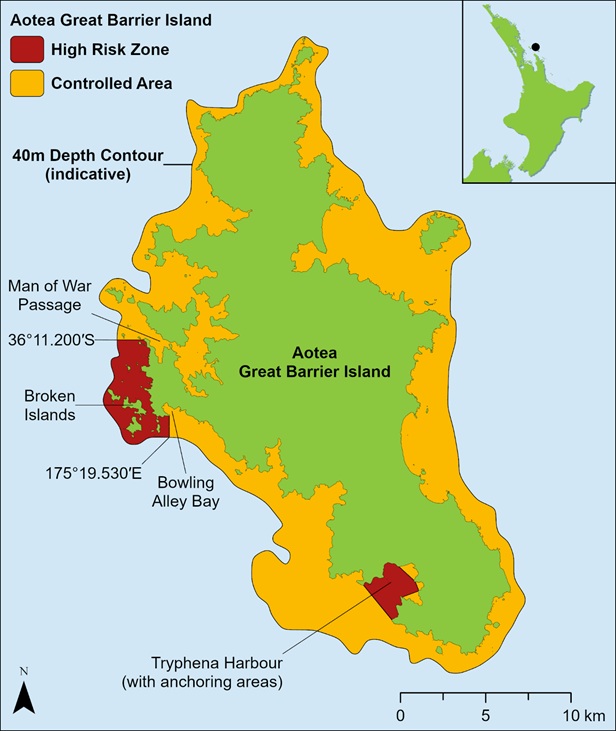
Yellow Zone:
Anchoring is allowed in the yellow zone. However, before moving location (either within the controlled area or out of the controlled area), operators must:
- check the anchor and chain for any attached seaweed
- remove any seaweed and store it securely in a bag or container so it cannot get back into the sea, then dispose of it on land
- clean any equipment thoroughly before using it in another area.
In the yellow zone, no fishing is allowed that uses a method that disturbs the sea floor. The following are prohibited:
- dredging
- bottom trawling
- flounder netting.
The following fishing activities are allowed in the yellow zone.
- Line fishing using a rod or handline from the shore, jetty or an anchored vessel.
- Drift fishing from a vessel.
- Cray or crab-potting.
- Spear fishing and hand gathering.
- Shore-based longlining (for example with a kontiki or drone) and diving.
Red Zone:
There are 2 red zones at Aotea Great Barrier Island. These are around the Broken Islands and in Tryphena Harbour. In these 2 areas, anchoring is illegal without a permit issued by Biosecurity New Zealand. A permit is not required in the event of an emergency where there is no other safe sheltering or mooring location.
In the Red Zones there are tighter controls, and the following is not allowed:
- Anchoring – except in an emergency or with a permit in exceptional circumstances from Biosecurity New Zealand. (for permit link go to MPI website.)
Fishing activities that make contact with the seabed:
- trawling
- dredging
- flounder netting
- crab/cray potting.
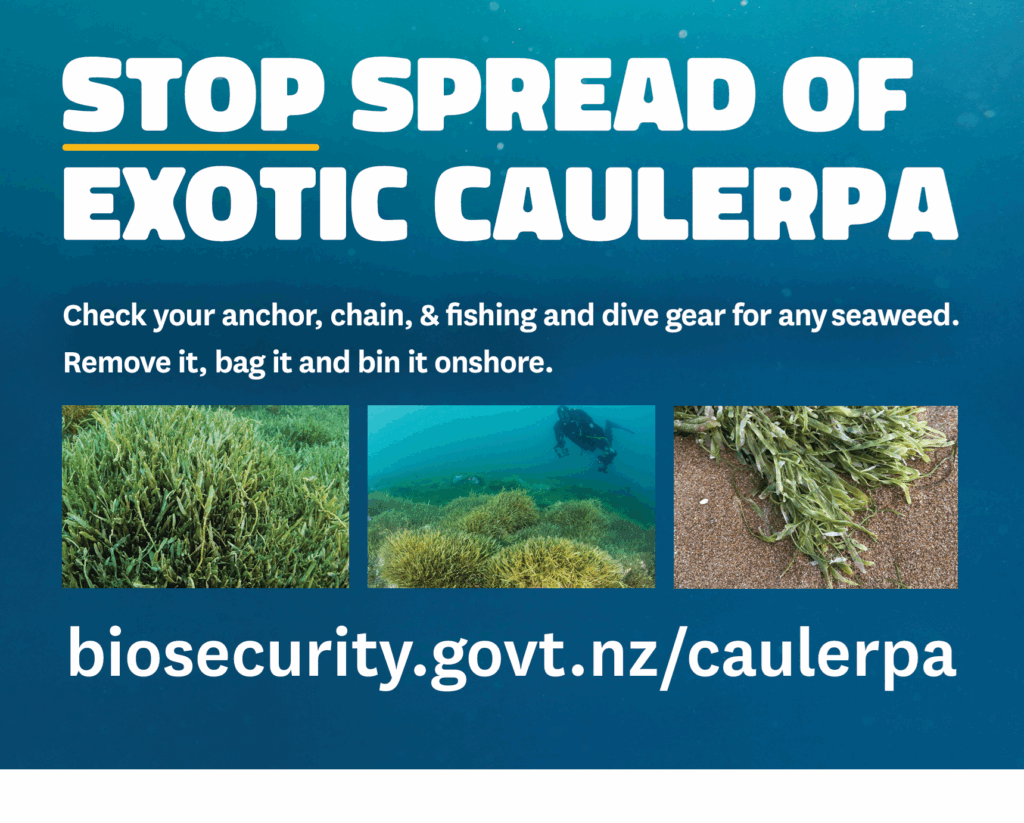
STOP THE SPREAD OF EXOTIC CAULERPA:
If any seaweed is found attached to equipment, it must be removed and securely bagged or contained and taken ashore for safe disposal on land – for example in a rubbish bin or compost. The key is ‘securely’ containing it as this stops it getting back into the water at a different location. If this can’t be done, people are asked to return it to the waters it came from. There will already be exotic caulerpa there and putting it back in this area will not pose a significant risk of spread.
The ‘Stop the Spread of Exotic Caulerpa’ campaign was rolled out through the places boaties and fishers frequent – targeted social media, digital ads on marine and weather websites and mainstream and Māori radio.
Brochures and signs are in production for use in locations across the upper North Island – the areas where boaties go and where exotic caulerpa could find suitable habitat to establish.
Full information about the updated CANs is on the MPI website.


